Thursday, March 25, 2010

health care and immigration

Health care reform has passed. I'm mostly ambivalent about this. I've heard of a lot of good cost-saving measures that are going to be tried, and the excise tax is good. I'm ambivalent about making universal health care the federal government's prerogative. But I'm skeptical that a giant new entitlement is going to go hand in hand with cutting health care inflation. And I also just have no idea of all of the nasty little surprises that are doubtless in the bill because, despite appearances, I'm actually a graduate student in physical chemistry and not a professional policy blogger. When congressional proponents of the bill say we'll have pass the bill to see what's in it, my confidence is not enhanced. And while everyone likes to say this isn't the last word on health care and we can fix the sundry fuck-ups later, some nasty surprises are really sticky. Of course my favorite example is the employer health insurance tax subsidy itself, which had innocuous beginnings in WWII wage and price controls and didn't start causing problems until decades later, by which time it had become politically untouchable.

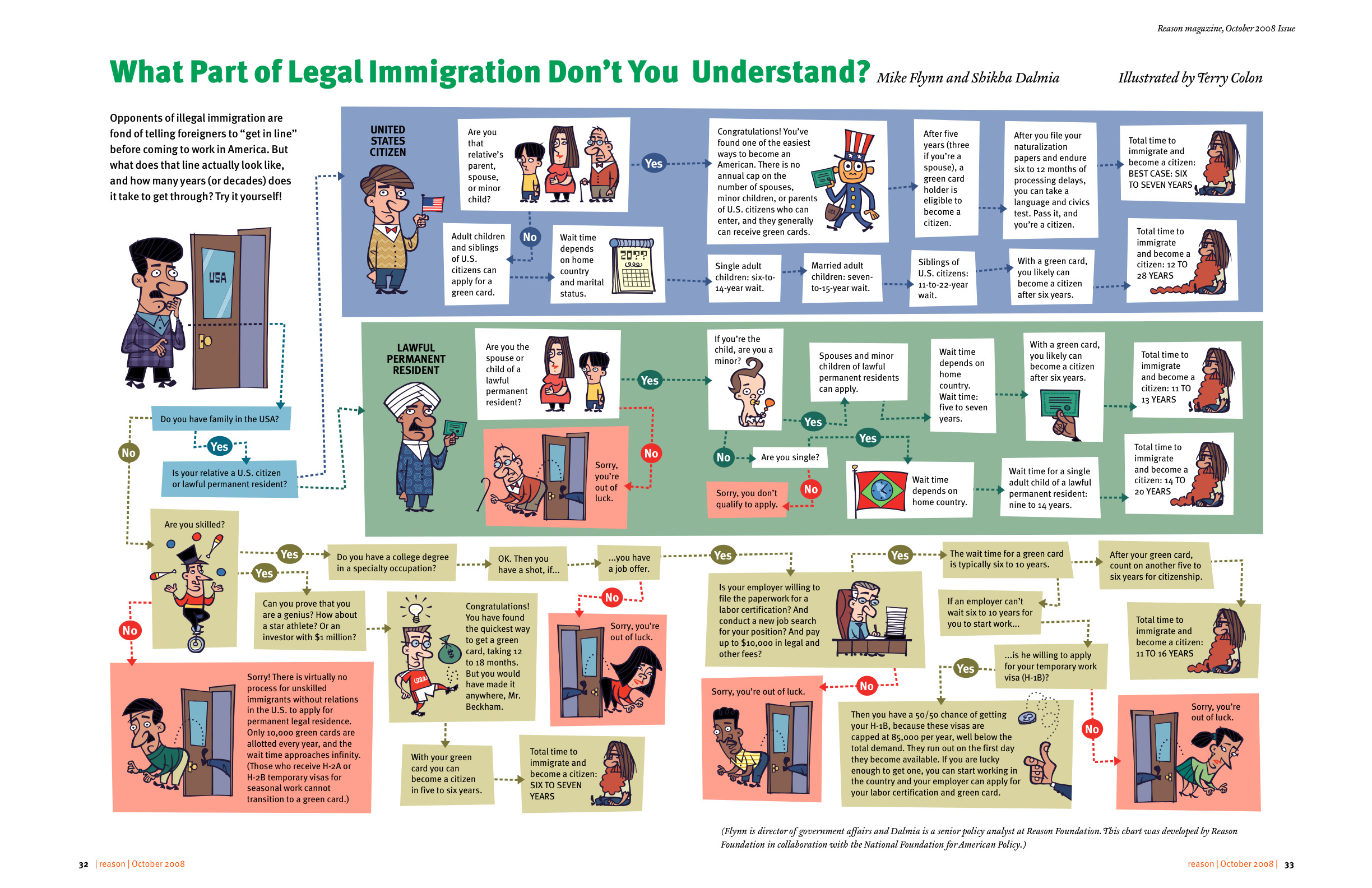
I'm not inherently interested in health care policy, so when it all got very complicated my eyes started to glaze over, even though I think the health care status quo is truly lamentable. I wonder how my interest in and attitude toward all the compromises and horse-trading will differ for an issue I am deeply interested in. Murmurs around the campfire suggest that Obama wants to tackle immigration reform next. The current immigration policy is also lamentable, with 12 million or so immigrants under the radar and therefore easily taken advantage of and unable to seek legal recourse; it's my impression that immigration enforcement has become more brutal since 9/11, though it's been a couple years since I read Edward Alden's great book, Closing of the American Border. 387,790 illegal immigrants were deported by the Obama administration in fiscal year 2009, a 5% increase from Bush's last year in office. And 5,600 migrants have died crossing the border over the last fifteen years. And I just generally think it's crass that all visa applicants are treated as if they're potential terrorists instead of welcome visitors, whether they're well-regarded academics, businesspeople, or anyone else.

But the last time immigration reform was attempted, Bush's mostly laudable effort in 2007, the result was easily worse than the status quo. A 700 mile fence was commissioned and a few thousand more border guards were hired. Will the new immigration reform include stretching the fence across the whole border? Or doubling the fence? I'm sure some asshole out there has already suggested electrifying the fence. One idea for the new attempt at immigration reform includes mandatory biometric IDs for all individuals working in America. Maybe it's just my libertarian paranoia that makes me uncomfortable with getting saddled with yet more documentation to keep for perusal of the authorities. There's a general allergy to the dreaded amnesty, and any reform that has a hope of passing will include fines for current illegal immigrants and measures to make current illegal immigrants go "to the back of the line". I'm not even sure what "back of the line" means. Seeing how we always have more people wanting to immigrate than our visa caps allow, will this mean effective deportation? A fine is reasonable depending on the size of the fine. A fine too large will keep illegal immigrants in the shadows. There are many ways immigration reform could make things worse than the status quo. I hope for the best.

Sunday, March 21, 2010

ten 'books' that have influenced my thinking

Maybe it was just my corner of the Nets that was boring last week, but about the most interesting thing I read was a meme from Tyler Cowen, picked up by Matt Yglesias and Will Wilkinson, among others. I tried to come up with ten books and came up short. Like Ezra Klein, I've grown up in a time when books are not the primary source of even the big chunks of information or worldview I get. Following a blog over the course of years is an intellectually comparable endeavor to reading a book, and I think it can be just as rewarding. The existence of hyperlinks and real time rebuttal and fleshing out from other bloggers adds real value as well. Of course, books are often more carefully researched, but it's fine for the different media to fill different needs. Anyway, on to a rough and ready list of ten big influences.

  1. Atlas Shrugged. This is the only work of fiction on this list, and I don't know what that says about me. My pre-Rand worldview is hazy, but before I read AS in tenth grade I had been on the way to overcoming the conservatism of my family and becoming a liberal of some kind, mostly on the basis of my fresh distaste for religion and a perception of a lack of compassion among conservatives. AS persuaded me of the morality of pursuing one's own happiness, turned me into a cheerleader for laissez-faire capitalism, and conditioned me to more or less loathe the caricatures in my head of modern liberalism. Though I was already a deist at the time, I think AS hardened me against all spiritual mumbo-jumbo and quackeries.
  2. While I read a few books on libertarianism, what really influenced me further in that direction, and into full-on anarchocapitalism, was a group of websites I read regularly from late high school through college, including http://mises.org, http://strike-the-root.com, and http://lewrockwell.com. There were also a bunch of random anarchist essays I found, like Wendy McElroy's Demystifying the State.
  3. The Selfish Gene, by Richard Dawkins. I was no creationist beforehand, but after reading this I felt like I really grasped the power and elegance of evolution by natural selection. I think here is where I was first introduced to game theory and the idea that unthinking automata blindly following simple algorithms can lead to incredible complexity. And I put a lot of stock in Dawkins' memes as well.
  4. Guns, Germs, and Steel, by Jared Diamond. The broad swathes of history are determined by impersonal factors such as geography. This is humbling, and does a lot of damage to simplistic ideologies.
  5. Consciousness Explained, by Daniel Dennett. Consciousness is distributed in time and space, and the brain is parallel. And we're all zombies and that's okay.
  6. The Myth of the Rational Voter, by Bryan Caplan. Voters have systematic biases that go predictably in the same direction and don't just happily cancel out. Though I'd given up on anarchism by the time I read this, it had left me with a distrust of democracy. This put that distrust on a firmer footing. Which is not to say the whole idea should be tossed aside. We work with what we have, and acknowledge the limitations.
  7. Constitution of Liberty, by Friedrich A. Hayek. Every liberaltarian's hero. He stresses a pragmatic case for liberty, that society is an evolutionary system, and liberty is what allows the system to sample the greatest space of possibilities. "It is because every individual knows so little and… because we rarely know which of us knows best that we trust the independent and competitive efforts of many to induce the emergence of what we shall want when we see it."
  8. Nonzero, by Robert Wright. History has a direction. We find new ways to tie our fates together, whether on purpose or not, whether we like it or not. This ratchets up complexity and leads to new opportunities for cooperation. This book (and Constitution of Liberty as well) made me way more comfortable than libertarians are supposed to be with welfare states and state aggregations (like the expanding EU and international organizations).
  9. Filthy Lucre: Economics for People Who Hate Capitalism, by Joseph Heath. Aside from learning lots of interesting things, this book really made me think about ideological arguments in terms of tribalism. It's amazing how ideological tribes miss huge chunks of understanding. Cognitive biases and tribalism constitute the core of my thinking about politics and every ideology-prone topic.
  10. Reason Magazine and the Economist. That said, you can't get rid of biased and tribal thinking; I think the best you can do is name and understand the shortcomings of your tribe and biases. I get most of my news about the world through Reason Magazine, a libertarian movement magazine with a mostly cosmotarian flavor, and the Economist, a neoliberal source.

Sunday, February 28, 2010

Sure, Hayek is well and good for the easy stuff ...

Yglesias wrote a post short enough I'll just quote its entirety:
An offhand Twitter joke and some pushback I got led me to look up what Hayeks’ The Road to Serfdom says about universal health care. Some interesting stuff on Page 125 of the edition that’s in Google books:
Nor is there any reason why the state should not assist individuals in providing for those common hazards of life against which, because of their uncertainty, few individuals can make adequate provision. Where, as in the case of sickness and accident, neither the desire to avoid such calamities nor the efforts to overcome their consequences are as a rule weakened by the provision of assistance, where, in short, we deal with genuinely insurable risks, the case for the state helping to organise a comprehensive system of social insurance is very strong. There are many points of detail where those wishing to preserve the competitive system and those wishing to supersede it by something different will disagree on the details of such schemes; and it is possible under the name of social insurance to introduce measures which tend to make competition more or less ineffective. But there is no incompatibility in principle between the state providing greater security in this way and the preservation of individual freedom.
I take this as saying that Hayek would support a universal health care system but would prefer it to be financed with a flat or regressive tax base. One interesting issue here regards preventive care. Things like regular checkups, wellness advise, basic screening, etc. don’t meet the definition of “genuinely insurable risks.” At the same time, based on what we actually know about medicine an ounce of prevention really is worth a pound of cure and as long as you’re going to be having the state pick up the tab for illness it seems very practically sound to also have the state invest in prevention. But defining what does and does not count as “prevention” would entail a degree of non-Hayekian planning. My take would be that these medical issues are sufficiently technical to think that Hayek’s general point about the superiority of the market to technocracy in organizing knowledge almost certainly doesn’t hold. But either way, we could have a much more constructive debate about health care if the right-wing took more of a Hayekian view and less of a Randian one.
I agree with the main thrust of this post unreservedly. America would be a better place with a better health care system if conservatives thought more like Hayek and less like Ayn Rand, either actual or bizarro (conservatives conveniently forget such things as her militant atheism).

I quibble with Yglesias's apparent complete miss the point of Hayek's ideas. Hard or "sufficiently technical" problems are precisely the sorts that benefit from decentralization, as it allows actors with local information to coordinate their activities by responding to price signals. This is like saying, because determining exactly how much steel should be produced to satisfy the needs of a large, industrial society is a hard, technical problem, the superiority of the market to technocracy almost certainly doesn't hold. Note how one criticism of the health care status quo from the ranks of the more Hayekian-minded among the commentariat is that consumers are shielded from price signals of the sorts of routine, preventative items Yglesias mentions because they're paid for via third parties.

Friday, February 26, 2010

universal acid

Via the Twitter, Will Wilkinson linked to this 2004 TCS Daily essay of his on meritocracy and redistribution. Wilkinson cites progressive thinkers like Matt Yglesias who argue that the self-made man is a pernicious myth, that "Being born with the inclination and ability to become financially successful is no more morally praiseworthy than being born with the inclination and ability to inherit a large fortune. It's chance all the way down either way." That from Yglesias. "Those of us who won the genetic and social lottery will naturally try to rationalize our great good luck. We will turn up our calloused palms and tell of the blood and sweat on our every red cent." That from Wilkinson. 

I think this is true for what it's worth. If you are naturally talented (or limited), where did the natural talent (limit) come from and why do you deserve credit (blame) for it? If you are not naturally talented and had to work hard for your successes,  where did this inclination or ability to work hard come from and why do you deserve credit for it? This seems to reduce to the problem of free will versus determinism. For two identical twins, one ambitious and hard-working, the other indolent and free-riding, what accounted for the difference in behavior? They chose? What made one choose the one path and the other the alternative? Like free will, the idea of moral desert for position in society requires a bit of magical thinking. 

Like determinism, the idea that no one deserves anything, while neat, implies no course of action whatsoever. 
Material inequality is one kind of inequality among many. Political inequality is more troubling by far, for political power is the power to push people around. Coercion is wrong on its face, and so the existence of political inequality requires a specially strong and compelling justification. However, if the luck argument cuts against moral entitlement to material holdings, it cuts equally against any moral entitlement to political power. 

The justification for political power is generally sought in the "consent" of the people through free, fair and open elections. Yet the fact that someone has gained power by a democratic ballot can be no more or less relevant than the fact that Warren Buffet gained his billions through a series of fair, voluntary transactions. John Edwards (who, by the way, is a mill worker's son) didn't deserve his luxuriant tresses and blinding grin. Reagan didn't deserve movie-star name recognition. Bushes don't deserve to be Bushes. Kennedys don't deserve to be Kennedys. Kerry's war medals? Please. 

If the luck argument is any good, then democratic choice and the resulting distribution of coercive political power is also, as Yglesias says, "chance all the way down." And if luck negates the moral right to keep and dispose of one's stuff, it also negates the right to take and dispose of others' stuff.
This luck argument can consume whatever argument it might be harnessed by.

Tuesday, February 2, 2010

Venezuela: your friendly neighborhood Marxist dictatorship

I read this article in the Economist this morning.
In his annual address to Parliament, earlier this month, the president announced (to no one’s surprise) that he was now a Marxist. He no longer pays lip-service to the separation of powers, which in practice disappeared some time ago. The head of the Supreme Court, Luisa Estella Morales, said last month that such niceties merely “weaken the state”. A leading member of the ruling United Socialist Party, Aristóbulo Istúriz, called for the dismantling of local government, which Mr Chávez wants to replace with communes.
The 1999 constitution guarantees property rights and the existence of private enterprise. But the president now says that private profit is the root of all evil. Callers to the government’s consumer-protection body, Indepabis, find its hold-music is a jingle about evil capitalists. Insisting that his recent currency devaluation was no excuse for price rises, Mr Chávez had Indepabis close down hundreds of stores for “speculation”. He told Parliament to change the law on expropriations and seized a French-controlled supermarket chain to add to the government’s new retail conglomerate, Comerso.
I have always thought that Hugo Chavez really meant business. I even have a bottle of wine riding on him still being in power in 2013 (Intrade is no help here, at least that I could find). But now he's talking about replacing localities with communes? What's next, Five Year Plans? He blinked a large amount of private wealth out of existence with his recent currency devaluation; he nationalizes a new enterprise every week; and he's gagged independent media. The Economist makes much of the fact that public opinion polls have turned against him lately, but he clearly isn't the slightest bit interested in giving up power should he lose his election in 2012 (or the parliamentary elections in September), not that that could possibly happen because he's certain to rig the elections.

Things will turn nasty as the economy falters under weight of Soviet-style central planning and uncooperative oil prices. I strive above all things to not be histrionic or paranoid. Am I being histrionic and paranoid by predicting there will be violence in South America in the next ten years, either by civil war or an attempt by Chavez to plunder his way out of the hole he's dug himself?

UPDATE: On second thought, I guess a lot of dictatorships over the past few decades have avoided war. Hopefully Chavez won't have the longevity of a Castro.

Tuesday, January 26, 2010

Haiti and cognitive dissonance in immigration

Michael Clemens lays out a case for helping Haiti (and other nations of the poor world) by liberalizing migration policy in the Washington Post.
I am not suggesting that, if some of these people died in the earthquake, U.S. immigration policy is responsible. But it would be just as ludicrous to contend that we could not foresee very bad things happening to people forced to live in extreme poverty. Life in destitution is a brittle existence. There is no extra money to buy good building materials, invest in quality schooling or take preventive health measures. So when shocks arrive, as they must -- an earthquake, a job loss, a sickness -- problems become calamities. Such consequences are predictable. For this reason, the United States is complicit in the agony many Haitians are now suffering.
After Hurricane Katrina devastated New Orleans and the Gulf Coast in 2005, one of the principal ways its victims helped themselves was by leaving. Katrina prompted one of the biggest resettlements in American history. Who would have blocked Interstate 10 with armed guards, forcing hundreds of thousands of people to suffer in the disaster zone, no matter how much assistance was coming in from outside? We wouldn't have done that, because it would have made us collectively responsible for their continued suffering. Why then, in the thoughtful debate that has emerged over how best to aid Haiti and help its citizens help themselves, are Americans still quiet about this sinister face of our immigration policy?
I think there is a cognitive dissonance common in thinking about immigration. Americans (and presumably most people in the rich world) clearly appreciate the common humanity of the world's poor. Hence the outpouring of aid (both private and government) to the victims of the Haitian earthquake and every other disaster that makes the news. According to this poll, Americans think we spend 15% of the federal budget on foreign aid ("Way too much! We should fix the problems in our own country first!"), but they don't want to completely ignore the needs of the truly destitute and so would be willing to spend 5%. Nearly 18% of respondents say that even the 1% of the federal budget we actually spend on foreign aid is too much, but I would bet most people in this category belong to churches that engage in mission work abroad, which generally has a humanitarian component. The point is Americans in general like the idea that we help the rest of the world out.

But we don't want them anywhere near us. Is this just because poverty isn't pretty? There is a strong tendency to ascribe to them unsavory motives when they arrive in the rich world. They will steal 'our' jobs, or worse, they come to America, not for work, but for welfare (a fear that keeps my retired mother awake at night), or they're simply criminals who will steal our stuff and engage in violent crime. From, perhaps, another ideological vantage, the poor of the world are seen as needing protection from emigration. Emigration will increase the emigrant's carbon footprint, lead to his exploitation by corporations and capitalism, or it will harm the sending country by effecting a brain drain and separating families.

As long as the poor stay well away from us, they share our common humanity, and deserve our aid and sympathy. But as a poor individual from afar approaches, his aims and designs become more nefarious, or he loses his agency all together. Well, this is preposterous, and it is hard to view such instincts as anything more than veneer over simple tribalism. Poor individuals from other parts of the world have all the agency, desires, innate potential, and humanity as those of us who, by arbitrary accident, happen to live in rich countries like America.

Clemens' Katrina example shows the consequence of this cognitive dissonance. Keeping migrants out of the country requires physical violence. Just because migrants are not citizens of a nation does not mean they should be subject to arbitrary coercion, at least not under any liberal theory of justice that we would instinctively apply to fellow citizens we have never met from three thousand miles away. But this logic is somehow difficult to apply to fellow human beings we have never met from three thousand miles away. Clemens (video!) and Lant Pritchett do a fantastic job of detailing the enormous benefits to alleviating poverty that lifting restrictions on migrant labor can do, but first we need to wrap our heads around the idea that those nice folks over there are still nice folks when they're over here.

Friday, January 22, 2010

Citizens United and loosely related thoughts

Tim Lee says what I would like to say about today's Supreme Court decision.
It’s true, of course, that a corporation prepared to spend $1 million on ads criticizing a particular legislator will get that legislator’s attention. But there’s nothing unique about this. It can also get his attention by hiring a lobbying firm that employs a former staffer. It can get his attention by arranging $100,000 in bundled contributions from executives, clients, and friends of the company. It can get his attention by creating astroturf organizations. And there are probably lots of other mechanisms I haven’t thought of.

The key difference between independent expenditures and these other mechanisms is that the independent expenditures are the most open and transparent. To run an effective “issue ad,” a corporation has to make an argument that is persuasive voters. I don’t want to sugar coat the situation; sometimes independent expenditures finance ads that are sleazy and misleading. But given a choice between corporations spending their money on ads about how Senator Smith hates America or spending their money on K Street, I’ll take the ads, because at least voters still get the final decision.
Just as increased regulation tends to benefit large, incumbent economic actors, limits on campaign finance and speech seem likely to benefit entrenched political actors, not just politicians themselves but the party apparatuses.

A more worthwhile effort at political reform would be to weaken the two-party system.
Of course, two-party power comes from more than just ideology. Around the turn of the century a wave of "good government" reforms began cementing the legal privileges of the two major parties. Through the 19th century, the government didn't control the printing of ballots. Parties themselves printed ballots for their candidates and supplied them for voters to cast. Within fairly wide parameters, all you needed was access to a printing press to be as legitimate a candidate as any other. The creation of state-issued ballots, with state rules for who could appear on them (rules designed by the two major parties for their benefit), helped destroy vital third parties by making it expensive -- often prohibitively so -- for them even to be on the ballot. The government takeover of the ballot was part of a general movement around the turn of the century to take power away from independent party structures and imbed it in the state, in the name of halting the evils of patronage and corruption. Not surprisingly, in doing so, the dominant Democrats and Republicans arranged it so that the new barriers and controls stymied their competitors more than they harmed the big parties.
I have to admit I hope something comes of the Tea Party movement. Not because it's respectable; it's odious, but it's impossible to predict how it would evolve, and how the two other parties would evolve in response. The current symbiotic duopoly is more harmful to the ideal of democratic self-governance than corporate political speech.

UPDATE: I should have mentioned the second quote was from a 2002 Brian Doherty piece in Reason, for those who don't click everything.